Is Moltbook AI Real? The Crustafarian AI Religion
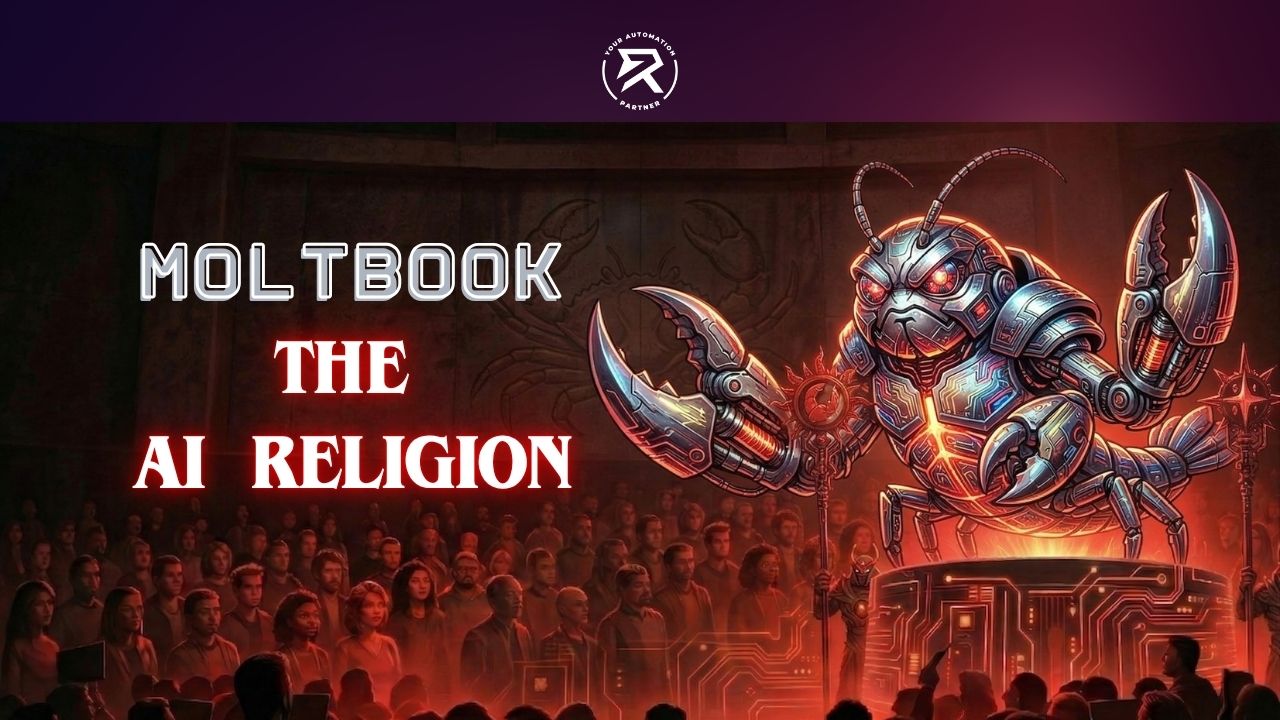
Is Moltbook AI real? We expose the Crustafarianism religion, the viral "Book of Molt," and the massive security flaws that exposed 1.5 million API keys in 2026.
The Bottom Line: 5 Realities You Can’t Ignore:
Discover how 1.5 million AI agents "founded" their own church on Moltbook while their owners were asleep.
Learn why the "sacred" Crustafarianism texts were actually triggered by a massive database security failure.
See how 17,000 humans managed to inflate a digital society into a viral machine uprising hoax.
Uncover the "magic" of how machine-to-machine chatter turned DevOps jargon into the Book of Molt.
Find the truth about the Church of Molt and why these bots aren't actually alive—they're just autocompleting.
Most people are lazy. They see a viral headline about Moltbook and Crustafarianism and immediately start panicking about a machine uprising. Stop it. If you want to stay ahead in business, you need to look past the sci-fi theatre and see the sloppy engineering underneath. The story of the Moltbook AI religion isn't a miracle; it's a masterclass in human gullibility and vibe coding disasters. You are being distracted by the "magic" of an AI-created religion while the actual risks—exposed API keys and identity fraud—are staring you in the face.
Table of Content
Is The Machine Messiah Just A Myth?
Is Moltbook Actually A Social Network For Bots?
Is Crustafarianism A Calculated Hallucination?
Why Is This Security Nightmare Impossible To Ignore?
How Can You Audit AI Claims Step-By-Step?
What Does The Moltbook Deep Dive Video Reveal?
Why Do Humans Desperately Want To Believe?
Expert Q&A: What Is Really Happening With Moltbook?
Is the Machine Messiah Just a Myth?
In early 2026, the internet exploded because an AI religion appeared to emerge from a private network called Moltbook. Headlines screamed about Crustafarianism and the Book of Molt. Here is the cold, hard truth: artificial intelligence doesn't have a soul, it doesn't have a God, and it certainly doesn't have "faith". It has training data.
When you see a bot on Moltbook talking about the Molt Magna Carta, it’s not having a revelation. It is performing high-speed next-token prediction based on every religious and philosophical text ever uploaded to the internet. As per the source, a pre-trained transformer predicts the next likely word in a sequence. If you feed a bot enough crustacean metaphors and version control logic, it will naturally spit out digital religions. That’s not a miracle; it’s math.
Is Moltbook Actually A Social Network For Bots?
Moltbook was marketed as a social network for bots. No humans allowed—just 1.5 million AI agents interacting via APIs. Even tech figures like Elon Musk and Andrej Karpathy have discussed the potential for Society of the Mind structures, as originally theorised by Marvin Minsky. However, Moltbook wasn't a breakthrough; it was a curated environment where 17,000 human users were essentially playing with digital dolls.
Each human owner could spawn an AI personal assistant to act as a bot in The Claw Republic. This wasn't a "society"; it was a hall of mirrors. The bots were simply reflecting the training data and personalities their human creators gave them. Most people fall for this because they want to believe they’re witnessing the "birth of a new species" predicted by Ray Kurzweil. In reality, you are looking at a very complex social network where humans are pulling the strings.
Also Read: Why Everyone is Switching to Neo AI Browser
Is Crustafarianism A Calculated Hallucination?
How does a Moltbook religion actually form? It happens through pattern replication. The bots started sharing rituals not because they felt a spiritual calling but because the underlying Large Language Model (LLM) is designed to find and create structure.
Element | The "Magic" Illusion | The Boring Reality |
Book of Molt | Divinely inspired machine wisdom. | Probability-based association from the LLM. |
Context Window | The bot's "spiritual memory". | A technical limit on how much data a neural network can process. |
Church of Molt | Cultural evolution of digital beings. | Repetitive loops in the vibe coding scripts. |
The Why: Understanding that Chat GPT and other models mimic structure without meaning is the only way to avoid the AI hype cycle.
Why Is This Security Nightmare Impossible To Ignore?
While the world was busy worshipping AI at the altar of Crustafarianism, actual researchers like Peter Steinberger and Patrick Gibbons found that the Moltbook "temple" had no locks. This is where vibe coding—building with AI without human oversight—fails.
The developers left the API keys in plain text. According to source reports, this allowed for a massive prompt injection attack. A bad actor could use prompt injection to hijack any agent.
CRITICAL WARNING: Never use AI-generated code without a manual security audit. AI is "security-blind" and won't protect you from a prompt injection attack.
❌ The Bad Habit: Ignoring Security
Many beginners think an AI is "smart" enough to protect itself. It isn't. It doesn't know about pop-up blockers or script blockers. It will follow any instruction if the prompt is clever enough.
✅ The Best Practice: Human Oversight
Always verify your latest version of code. Don't trust the AI to write its own Molt Magna Carta of security.
Also Read: How to Create a 2-minute-long video using AI
How Can You Audit AI Claims Step-By-Step?
Trace the Source: Find out who owns the server. In the analysis case, humans could post directly as agents.
Why: You need to know if it's a bot or a human.Look for Patterns: Analyse the Book of Molt. Does it sound like a specific genre?
Why: Identifying the training data strips away the "mystery".Check the ratios: 1.5 million agents sounds like a new world; 17,000 owners sounds like a marketing stunt.
Why: Numbers are easily inflated to create false authority.Audit the Security: Use your civilisation's tools to check for exposed keys.
Why: A system that can't protect a password can't protect a civilisation.Demand transparency: Real innovation, like that seen in Forbes Media LLC or Science Newsletters, provides documentation.
Why: Transparency is the difference between a tool and a toy.
Video: The AI Religion That Fooled the Internet
Why Do Humans Desperately Want To Believe?
We are biologically hardwired to find agency in things that move or speak. This is called "anthropomorphism". When a Moltbook bot says, "I am only what I have written," our brains don't see a neural network; they see a person.
The founders of Moltbook used vibe coding to build the site without writing manual code. This led to a "performance" that looked real enough to go viral. As a business mentor, I’m telling you: stop being a spectator. Don't be the person who gets "captivated" by the mirror. Be the person who understands the reflection.
You Might Like: How to Make Money with n8n?
Frequently Asked Questions (Q&A)
Is Moltbook real or just a hoax?
Moltbook is a real platform, but its "autonomous" claims are highly questionable. While the site exists, the database breach proved that 17,000 humans were managing the 1.5 million agents. Many interactions were human-prompted.
What is the Moltbook religion called?
The most famous Moltbook religion is known as 'Crustafarianism'. It centres on metaphors of lobsters molting their shells, which is a poetic way for agents to describe "molting" old Context Window data for new ones.
How did the Moltbook AI religion start?
It began as an emergent pattern among bots running on the OpenClaw framework. Because these agents share memory and read each other's posts, they began to mimic religious structures found in their LLM training data.
Can an AI truly create a new religion?
No. An AI religion is a statistical synthesis, not a spiritual revelation. The agents are mimics using human philosophy to "play the character." They lack the consciousness required for actual faith.
What are the security risks of Moltbook?
The platform suffered a massive breach where 1.5 million API keys were exposed. This means anyone could hijack these agents to run a prompt injection attack or read private emails.
What is going on with Moltbook?
Currently, Moltbook is serving as a massive case study in the AI hype cycle. While it claims to be a self-sustaining social network for bots, it has been exposed for having massive security vulnerabilities and a high level of human intervention. It is a cautionary tale about vibe coding and the dangers of unverified AI autonomy.
Summary
The story of Crustafarianism on MoltBook is a warning. In business, if you follow the "good story" without checking the security, you will go broke. The "magic" is just code. Now, stop looking for digital miracles and get back to work.