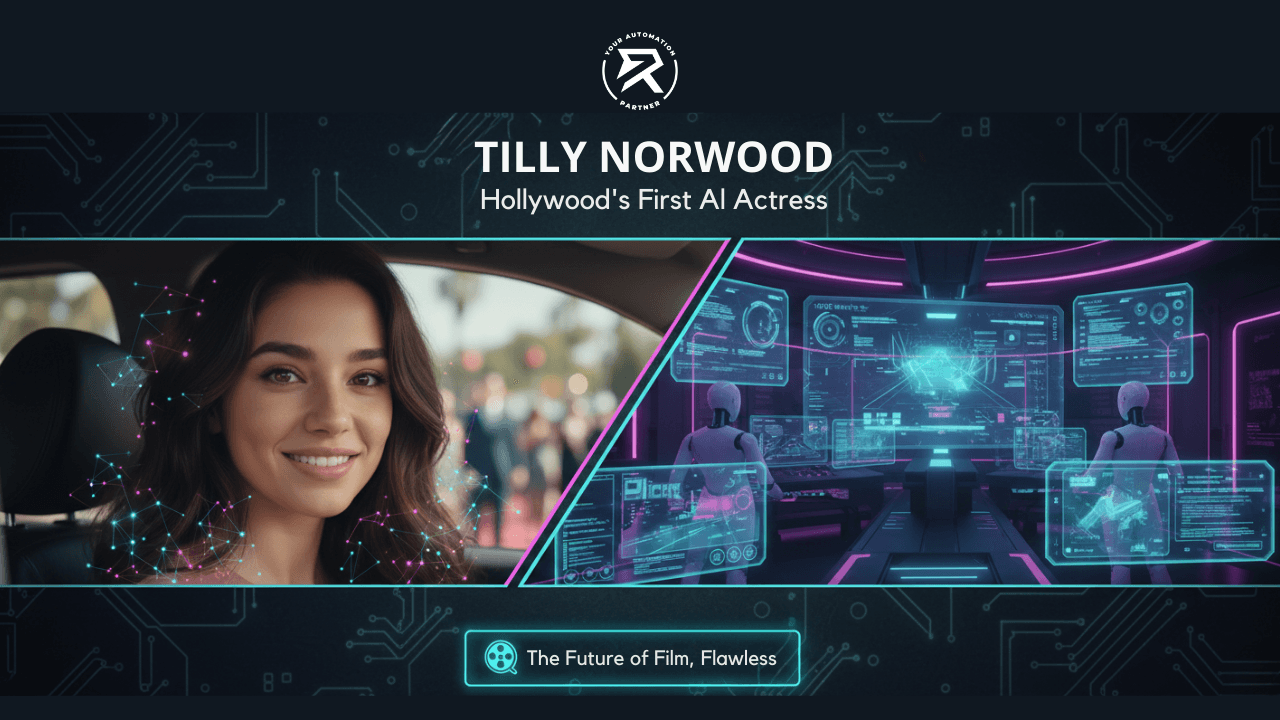
Tilly Norwood: Hollywood’s First AI Actress
Key Pointers:
Meet the AI Star: Meet Tilly Norwood, the first movie actress who isn't a real person—she is 100% digital.
No Humans Required: She acts, speaks, and shows emotions without needing a human body, voice actor, or motion capture suit.
Always On Duty: Tilly never gets tired, never ages, and can work on any movie at any time without taking a break.
Cheaper & Faster: Movie studios love AI actors because they save money and allow for unlimited retakes instantly.
Man vs. Machine: While the technology is amazing, real actors are worried about losing their jobs to computers.
Table of Contents:
Meet Tilly Norwood – The World’s First Digital Actress
How Does an AI Actress Perform?
Why Hollywood Is Turning Toward AI
The Artistic Debate: Human Emotion vs. Digital Precision
Global Ripple Effects – From Hollywood to Bollywood
The Tech Perspective: Innovation vs. Regulation
What Does This Mean for the Future of Entertainment?
Final Thoughts: The Beginning of a New Age
FAQ
The global film industry is witnessing a historic transformation — and this time, it’s not driven by a blockbuster release or celebrity controversy. Hollywood has introduced its first-ever AI-generated actress, Tilly Norwood. The UK-based AI studio Particle6 Group developed Tilly. She shows a clear move toward a future shaped by generative artificial intelligence. In this future, performances can be made, controlled, and delivered entirely by code.
Rather than serving as a visual effect or background enhancement, Tilly stands at the center of storytelling. Her arrival signals a new era in which synthetic actors and digital performers are becoming active participants in mainstream cinema.
Meet Tilly Norwood – The World’s First Digital Actress
Tilly Norwood made her public debut at the Zurich Film Festival during the Zurich Summit, an international forum dedicated to creative innovation and the future of cinema. Unlike traditional actors, Tilly does not exist physically. She is entirely built from computer-generated content, powered by generative AI systems capable of simulating a realistic human presence.
What distinguishes her from earlier digital characters is her autonomy. Tilly operates as a fully realized digital performer, demonstrating how synthetic actors can function without relying on motion capture, body doubles, or real-world models. Her design allows her to be reused, adapted, and directed across projects without physical constraints.
Key characteristics that define Tilly include:
No physical body, location, or on-set requirements
A consistent appearance that does not age or change
Continuous availability without scheduling conflicts
She relies on advanced AI facial animation to produce lifelike expressions and emotional nuance, paired with synthetic voice technology. There is no human performer behind her face or voice, reinforcing her identity as a fully autonomous digital creation engineered by an AI production studio.
How Does an AI Actress Perform?
The performance workflow of an AI actress mirrors traditional filmmaking — but replaces human labor with intelligent systems. When provided with a script, Tilly’s AI engine evaluates dialogue, emotional context, pacing, and intent before generating a complete performance.
This process typically involves:
Script comprehension through natural language processing
Emotional interpretation using generative AI models
Expression and movement via AI facial animation
Final output delivered as polished computer-generated content
Directors can fine-tune tone, emotion, pacing, and even language in real time. This level of precision allows synthetic actors to be adjusted instantly without reshoots, delays, or physical limitations, fundamentally altering how performances are created and refined.
Why Hollywood Is Turning Toward AI
Hollywood’s growing interest in AI performers is driven by three major factors: efficiency, control, and scalability. Digital performers remove many problems that come with human actors. They also give studios more control over performances.
Studios see value in AI performers because they:
Reduce costs related to travel, accommodation, makeup, and reshoots
Allow unlimited retakes without time pressure
Enable centralized control through an AI production studio
For producers, this represents a highly efficient production model. For many traditional Hollywood actors, however, it raises concerns about job security and creative displacement.
The Artistic Debate: Human Emotion vs. Digital Precision
While Tilly Norwood’s debut was widely praised as a technological milestone, it also sparked serious debate. Industry bodies such as the Screen Actors Guild–American Federation of Television and Radio Artists (SAG-AFTRA) have raised alarms about consent, compensation, and ownership in the age of AI-generated performances.
Critics say cinema is based on real human experience, feelings, and personal views. They believe machines cannot truly copy these qualities. The concern is that overreliance on synthetic performers could erode the emotional authenticity that defines storytelling.
Global Ripple Effects – From Hollywood to Bollywood
The implications of AI performers extend far beyond Hollywood. In India and other global entertainment markets, creators worry about AI systems being trained on copyrighted material without consent. As computer-generated content becomes more sophisticated, questions of ownership and fair use are gaining urgency.
In response:
Policymakers are reassessing copyright and intellectual property laws
Film organizations are advocating for licensing requirements
Global collaboration is increasing to protect creative rights
These discussions highlight how the rise of synthetic actors is reshaping not just production methods, but legal and ethical frameworks worldwide.
The Tech Perspective: Innovation vs. Regulation
Technology companies argue that excessive regulation could slow innovation in generative artificial intelligence, limiting its potential to enhance creativity across industries. Instead of strict bans, they advocate for responsible development frameworks that encourage ethical use while allowing experimentation and progress. From this viewpoint, AI is seen as a creative support tool—one that can assist storytellers, streamline production, and expand artistic possibilities rather than replace human imagination.
This perspective broadens the debate beyond cinema alone. AI performers now sit at the center of a wider cultural, legal, and technological discussion involving intellectual property, authorship, labor rights, and the role of automation in creative work.
What Does This Mean for the Future of Entertainment?
AI-generated performers like Tilly Norwood open new possibilities for independent creators and small studios. Affordable access to digital actors lowers entry barriers and enables experimentation without massive budgets.
At the same time, unresolved questions remain:
Who owns an AI-generated performance?
Who receives credit or compensation?
Will audiences value stories told by machines as much as those told by humans?
These issues strike at the core of the film industry, forcing it to redefine authorship, creativity, and authenticity.
Final Thoughts: The Beginning of a New Age
Tilly Norwood is more than a technological experiment — she is a symbol of a profound shift in how stories may be told in the future. As generative AI continues to blur the line between the digital and the real, the industry faces a pivotal choice.
Whether AI becomes a collaborative tool or a disruptive force will depend on how filmmakers, regulators, and audiences respond. The future of cinema may not lie in choosing between humans and machines, but in redefining creativity itself.
FAQ
1. Is Tilly Norwood based on a real person?
No. Tilly Norwood is not based on any real human being. She is a completely digital creation, with no physical actor, model, or real person behind her face, voice, or expressions.
2. How was Tilly Norwood created?
Tilly Norwood was created using advanced artificial intelligence technologies, including:
Natural Language Processing (to understand scripts and emotions)
Synthetic voice technology
AI-driven facial animation and rendering systems
These systems work together to generate her speech, facial expressions, emotions, and performances entirely through algorithms.
3. Who is the creator of Tilly Norwood?
Tilly Norwood was developed by Particle 6, a UK-based studio specializing in digital and AI-driven creative technologies.
4. Who is the AI actress in India?
As of now, India does not have an officially recognized, fully independent AI actress like Tilly Norwood. While there are experiments with digital avatars and AI-generated characters in Indian media, no AI actress has been formally introduced or established in Bollywood at the same level.